Our family has worshipped Devi Durga for about 145 years. The Puja was started by Late Shri Krishnalal Chattopadhyay, a landlord of Ruppur, and today the fifth generation carries it forward. Of the two traditions of Durga Puja, Vaishnavite and Shakta, we follow the Vaishnavite rituals. Every year the Puja falls in the months of Bhadra and Ashwin.
Making the pratima
Preparations begin after Shri Krishna Janmashtami or Rath Yatra. On these auspicious days we collect sacred soil from a nearby river, preferably the holy Ganga, mixed with cow dung, cow urine, soil from the doorstep of a brothel, and rice husk.
The skeleton of the idol is made of bamboo and hay. Two layers of soil are applied, and the idol is coloured with biodegradable colours, then dressed in a Banarasi saree, jewellery and daker saaj.
Mahalaya
Mahalaya marks the beginning of Devi Paksha. Bengalis wake up early to listen to Mahishasuramardini on Akashvani Kolkata, first broadcast in 1931. We go to the nearest water body to perform Tarpan, offering water and prayers to our ancestors, whose souls are believed to visit the earth during this period, so that they may find peace and moksha.
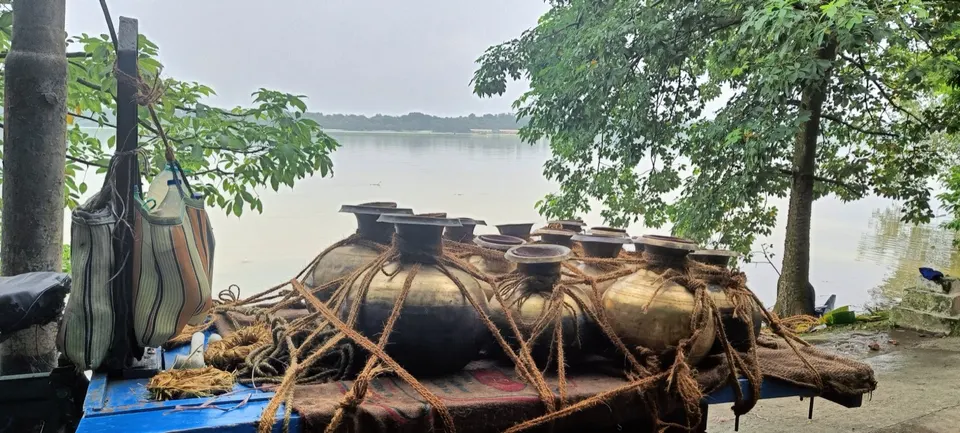
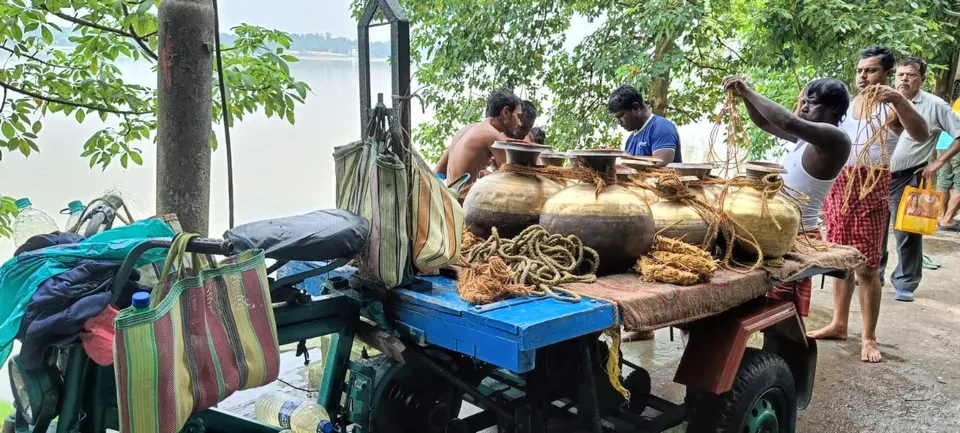
Early on this day, family members go to the Ganga ghat for Ganga jol tola: holy Ganga water is filled in large copper pots, tied onto a cart and brought home for the Puja.
We also prepare narkel naru (coconut sweets) in two flavours, sugar and jaggery. Only offerings made by our own family members are offered to Devi. Last-minute preparations are checked so that nothing is left out.
Sankalpa
Sankalpa in puja is a solemn, intentional declaration that sets the purpose, scope and results of a ritual. It acts as the mental and verbal commitment binding the worshipper’s mind, the ritual actions, and the deity invoked, so the sacred intention becomes the energetic cause for the desired outcome.
Prathama to Panchami
On Prathama, Devi is worshipped as Shailaputri. At our home the idol is not yet worshipped; instead a ghat (earthen pot) with a coconut is worshipped. Chandi Path is recited by the priest every day. On the following days Brahmacharini, Chandraghanta and Kushmanda are worshipped with similar rituals.
Bodhon and Adhibas — Shashthi
Bodhon (Akaal Bodhon). According to Hindu belief, the gods rest during autumn, so Devi Durga must first be ritually awakened before she can be worshipped at this "untimely" season. A water-filled copper kalash is placed at the base of a bel (wood apple) tree, or a branch of it, where the Goddess's spirit is invited to reside.
Adhibas. Before the main worship begins, the surroundings and the idol are sanctified: the deity and the bel tree are touched with 26 sacramental items.
Nabapatrika Snan — Saptami
At dawn, the Nabapatrika is bathed in a nearby river or pond while the priest chants Vedic mantras. A young banana plant is tied with eight other sacred plants (colocasia, turmeric, jayanti, wood apple, pomegranate, ashoka, arum and rice paddy) using yellow jute thread. Each plant represents a manifestation of Goddess Durga.
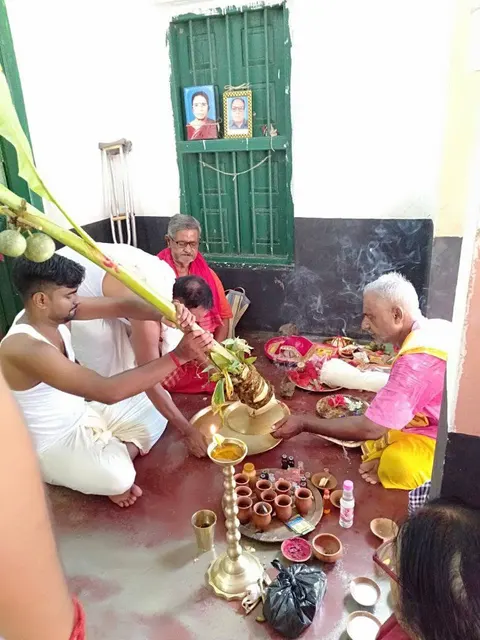
After the bath, the Nabapatrika is draped in a white saree with a red border, smeared with vermilion, and placed on a wooden pedestal to the right of Lord Ganesha. Then Pran Pratishtha is performed, invoking life into the Durga idol.
Pushpanjali — Ashtami
Ashtami is the most significant day of the Puja. Devotees fast in the morning and offer flowers and bel leaves to the Goddess for prosperity and the fulfilment of their wishes.
Sandhi Puja — Ashtami and Navami
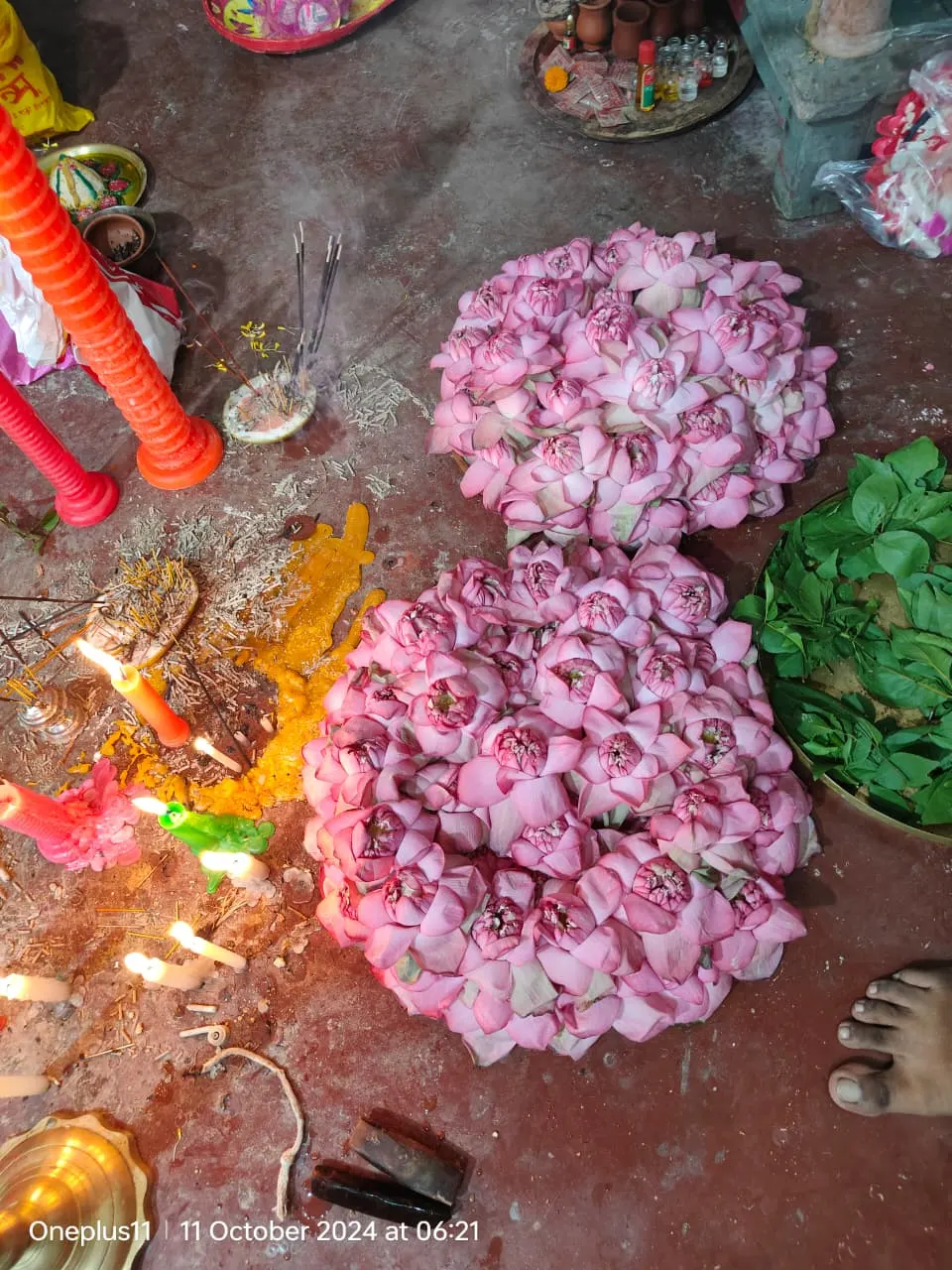
The climax of the Puja takes place in the precise 48 minutes when Ashtami ends and Navami begins. It commemorates the moment Goddess Durga manifested as Chamunda to slay the demons Chanda and Munda. 108 earthen lamps are lit and 108 lotus flowers and bel leaves are offered, along with a garland of 108 bel leaves and a chandmala, three circular discs of shola pith symbolising purity, beauty, peace and serenity. In our house, a special bhog of chhena (made from milk) is offered.
Kumari Puja, Hom and Dhunuchi Naach — Navami
After the Mahasnan and Shodashopachar puja comes Kumari Puja. A young girl between five and eleven years old is worshipped as the Goddess: her feet are washed with milk, alta is applied, and she is offered new clothes and gifts. Then the Navami Hom (Vedic yajna) is performed.
As the Puja nears its end, the night is made memorable with cultural programmes and the traditional Dhunuchi Naach, dancing to the beat of the dhak.
Vijaya Dashami
Dashami is the emotional farewell. It celebrates the Goddess's victory over Mahishasura and her return to Mount Kailash.
- Darpan Visarjan. The priest places a mirror in a large bowl of water. Two more bowls are prepared, one with water and turmeric and one with milk and alta. Devotees look into the three bowls to see the Devi's reflection, as her divine spirit departs from the idol.
- Devi Boron. Married women in red-bordered white sarees bid Ma farewell with sweets, betel leaves and sindoor, then smear sindoor on each other.
- Bishorjan. The idol is carried in a procession, to the beat of the dhak, to a nearby river or pond for immersion.
- Bijoya greetings. After the immersion, everyone exchanges Shubho Bijoya. The young touch the feet of their elders, and traditional sweets such as naru and nimki are shared.
Traditions unique to our home
- Bhog. Bhog is offered on Saptami, Ashtami and Navami, with a different lentil each day: moong on Saptami, chana on Ashtami and arhar on Navami. With it come rice khichuri, fried vegetables, vegetable curry, and payesh with small banana fritters soaked in it. A special mochar ghonto, made from banana stem and banana flower, is also offered. At night, luchi and narkel naru are offered.
- Aparajita armbands. On Dashami morning, after Darpan Visarjan, all the male members of the family wear butterfly-pea (Aparajita) vines as armbands, and the vines are tied around children's wrists for long life and protection. Devi Aparajita is revered as a fierce form of Devi Durga.
- "Shri Shri Durga Mata Sahay." After the immersion, we write these words on a banana leaf with a bel twig, using alta as ink, and place it reverently on Devi Durga's altar.
- A vegetarian Puja. Following Vaishnavite rituals, the family strictly avoids non-vegetarian food for the ten days of the Puja, and breaks the fast with fish or mutton on the eleventh day.