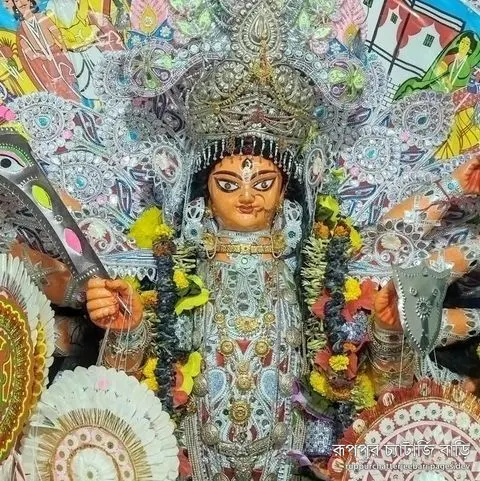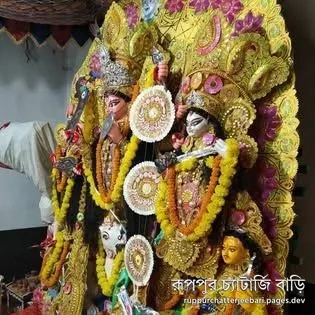
Walk through Kolkata during the Puja and you will see two very different worlds. In one, a pandal is shaped like a palace, a ship or a village from far away, and the goddess herself is sculpted in a style no one has seen before. In the other, Ma Durga stands with her children under a single frame, dressed in shola and silver, much as she has for generations. The first is a theme pujo. The second is a sabeki pujo, like ours.
From the zamindar's courtyard to the neighbourhood
For a long time Durga Puja in Bengal was the family celebration of wealthy households. In Kolkata, the Sabarna Roy Choudhury family has held its Puja at Barisha since 1610, probably the oldest Puja in the city.
The first step towards a Puja for everyone came in 1790, at Guptipara in Hooghly. Twelve friends, the story goes, were refused entry to a local zamindar's Puja, so they collected contributions and held their own. From baro (twelve) and yaar (friends) came the word barowari. The idea spread to neighbouring towns and, in time, to Kolkata, where community (sarbojanin) pujas became the heart of the festival.
When decoration became a competition
Once neighbourhoods ran their own pujas, they began to compete for visitors. In 1985 Asian Paints started the Sharad Shamman, an award for the best decorated Puja in Kolkata, and other awards followed. Committees began inviting artists to design the pandal, the idol and the lighting around a single idea. That idea is the "theme".
Today a theme pujo may recreate a heritage building, tell a social story, or turn a whole lane into an art installation. When UNESCO inscribed Durga Puja in Kolkata on its list of Intangible Cultural Heritage in December 2021, it praised the festival for bringing people together across religion, gender and economic background.
Where the sabeki pujo stands
A sabeki pujo does not change with the fashion of the year. What matters is continuity:
- the ekchala pratima, with Ma and her children under one frame;
- daker saaj and the painted chalchitra behind the idols;
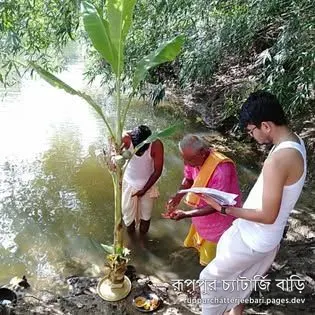
- rituals fixed by the panjika and by the family's own customs, handed down through generations.
At Ruppur Chatterjee Bari our Puja has followed the same Vaishnavite rituals since 1881. Nothing here is designed to surprise a visitor; everything is meant to be just as it was the year before.
Not rivals
It is tempting to set theme and sabeki against each other, but they belong to the same festival. Theme pujos have brought artists, craftspeople and millions of visitors into the Puja. Sabeki pujos keep alive the rituals and the look that theme artists so often draw on. If you visit Kolkata's pandals this year, we hope you will also come and see a family Puja kept the old way.