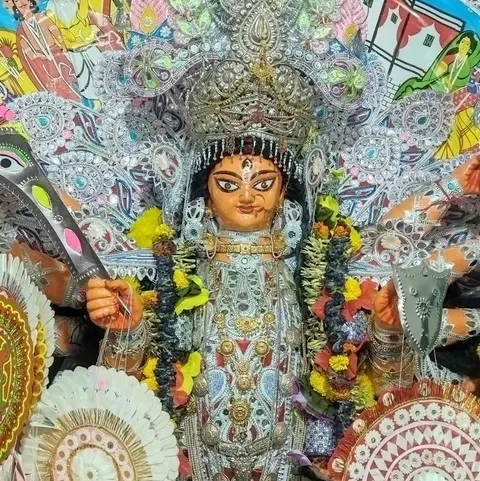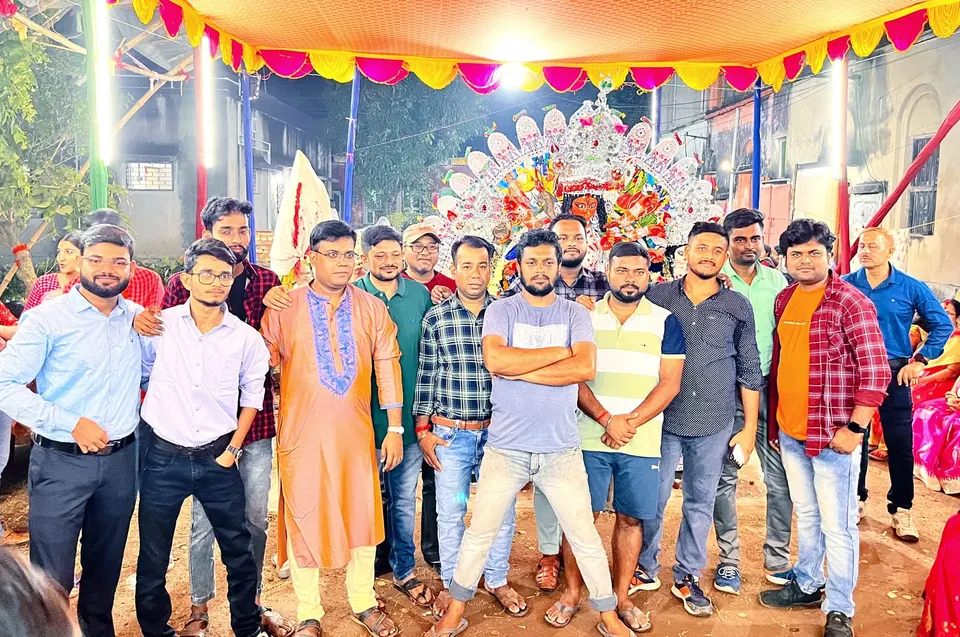
Long before the grand theme pandals of Kolkata, Durga Puja in Bengal was a family affair. Wealthy landowning families (the bonedi families) worshipped Ma Durga in the courtyards of their homes and opened their doors to the whole village. Many of these pujas, like ours at Ruppur Chatterjee Bari, are well over a century old and still going.
The Thakur Dalan
A Bonedi Bari Puja is held in a Thakur Dalan: a raised, pillared hall facing the courtyard, built specially for the Goddess. Villagers would gather in the courtyard for darshan, and the family's life would revolve around it for five days.
The ekchala pratima
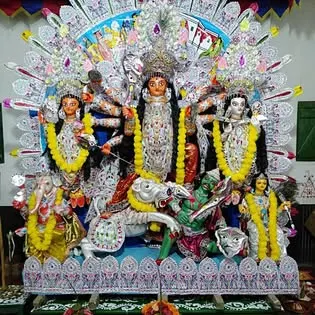
Most family pujas keep the ekchala ("one frame") style: Durga, Lakshmi, Saraswati, Kartik and Ganesh share a single frame, backed by a painted chalchitra showing scenes from the Puranas. The style has barely changed in two hundred years.
The family puthi
Each family follows its own handwritten ritual manual, the puthi, passed down through generations. Small differences, such as what is offered in bhog, whether Kumari Puja is held or how the Bishorjan is done, give every Bonedi Bari Puja its own character.
Bhog cooked at home
Bhog is usually cooked by family members themselves, often in the old kitchen on a wood fire. Khichuri, labra, luchi, payesh and a dozen kinds of sweets are offered to Ma and then shared with every visitor.
Why they matter
Bonedi Bari pujas are living museums of Bengal's culture. The rituals, songs, recipes and crafts they keep alive would otherwise be lost. If you visit one this Puja, arrive early for anjali, stay for the bhog, and talk to the elders. Every family has a hundred stories.
We would love to welcome you at our Thakur Dalan for Durga Puja 2026.