For five days every autumn, West Bengal belongs to Ma Durga. Offices close, cities stay awake past midnight, and people who left home years ago find their way back. Durga Puja is a religious festival, but in Bengal it is also a homecoming, an art exhibition, a street fair and the biggest event on the calendar, all at once.
A festival that belongs to everyone
For centuries the Puja was held in the courtyards of zamindars and wealthy families, the bonedi bari. That began to change in 1790 at Guptipara in Hooghly district. The story goes that twelve young men, turned away from a zamindar's Puja, collected money from the neighbourhood and held one of their own. From baro (twelve) and yaar (friends) came the word barowari.
The idea spread along the river and, in time, into Kolkata, where community or sarbojanin pujas became the heart of the festival. Today thousands of neighbourhood committees across the state hold a Puja, alongside the family pujas that never stopped.
Kolkata's Puja: the city that never sleeps
Nothing quite prepares a first-time visitor for Kolkata during the Puja. From Shashthi to Dashami, the city turns into one great open-air gallery.
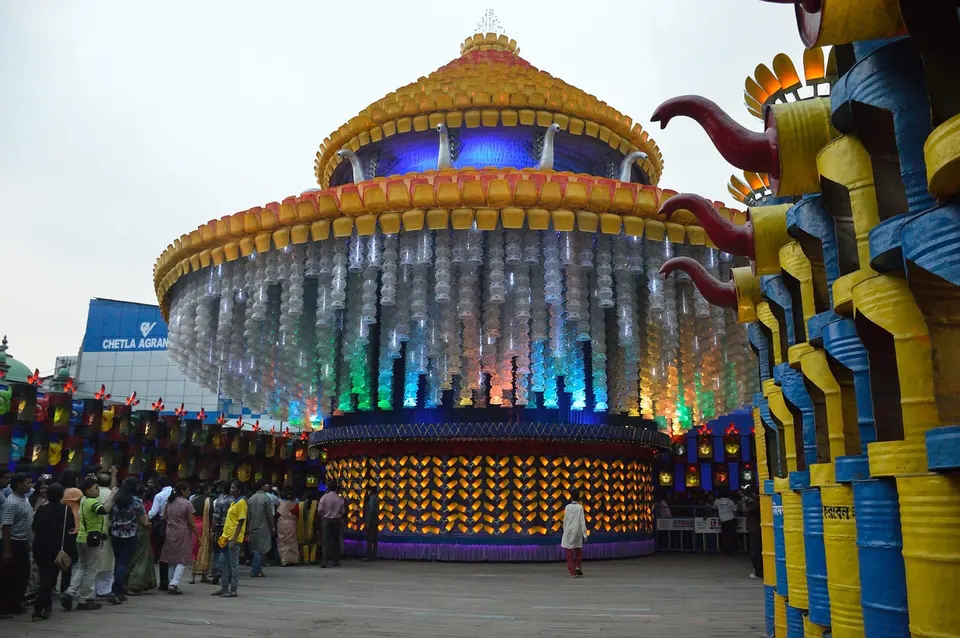
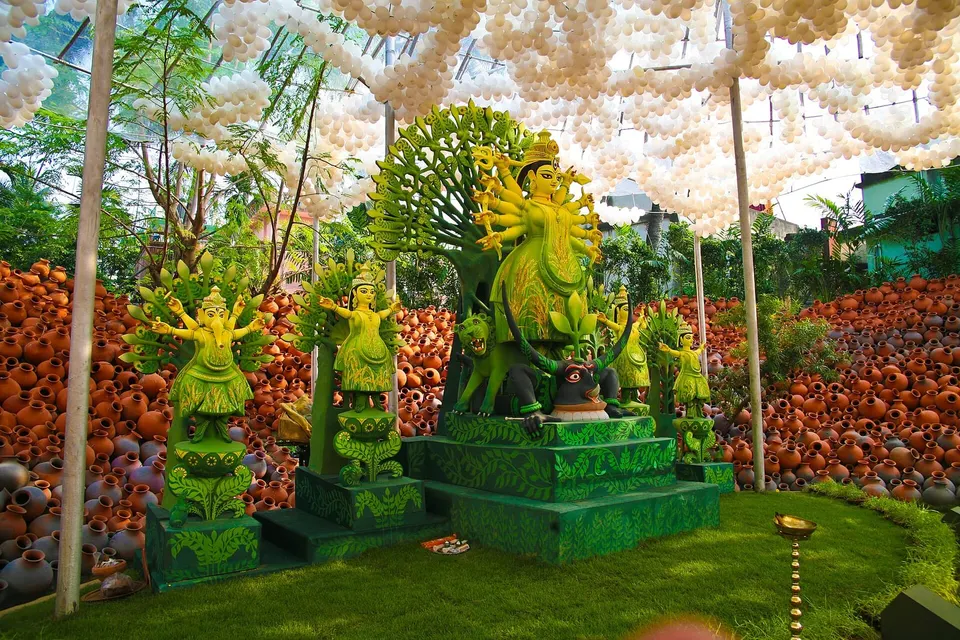
Theme pujo is its signature. Artists and designers spend months on a single pandal: a temple of clay cups, a palace of lights, an entire village built from jute or bamboo, or an idea about society turned into architecture. Pujas compete for awards, and the most talked-about pandals draw queues that stretch down the street.
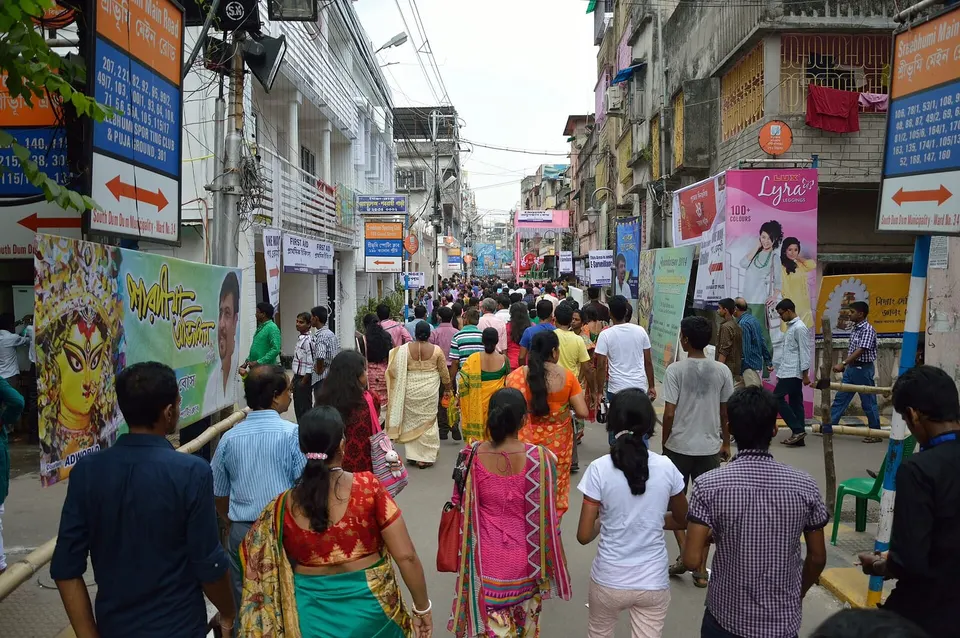
Then there is the feeling of the city itself:
- Pandal hopping late into the night, with friends and family walking from one neighbourhood to the next.
- Street food at every corner: phuchka, egg rolls, telebhaja and, of course, sweets.
- New clothes for every day of the Puja, bought after weeks of Puja shopping.
- The dhak echoing between buildings, the smell of dhuno at the evening arati, and endless adda.
- Lights everywhere, many of them the work of artisans from Chandannagar in Hooghly.
Behind it all stand thousands of craftspeople. In Kumartuli, the old potters' quarter of north Kolkata, idol makers work for months, and their pratimas travel to pujas across India and abroad.
Ekchala and barowari pratima: what is the difference?
Stand before a family Puja and then a big community Puja, and you will notice the goddess herself is presented differently.
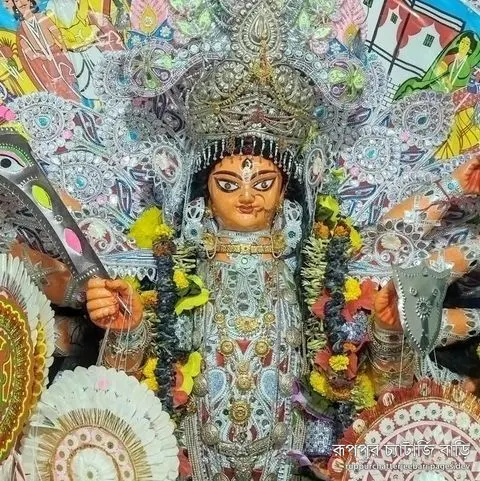
Ekchala pratima. Ek means one and chala means frame. Ma Durga, Mahishasura, the lion, and her children Lakshmi, Saraswati, Kartik and Ganesha all stand together under a single arched frame, with a painted chalchitra behind them. It shows the whole family arriving home together. The pratima is sized for the thakurdalan of a family home, the faces follow the traditional Bengali style with long, wide eyes, and the dress is usually daker saaj or shola. This is the sabeki form, and it is the form we keep at Ruppur Chatterjee Bari.
Barowari pratima. Community pujas have much more freedom. The figures are often sculpted separately, each with its own space, and are usually larger and more lifelike so that a crowd can see them from a distance. In theme pujos the pratima may be reimagined altogether, in materials, colours and forms chosen to match the pandal's idea.
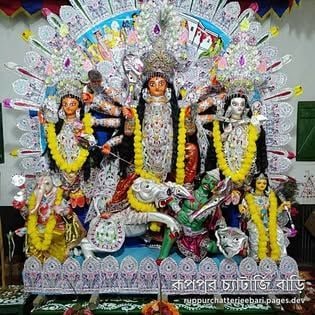
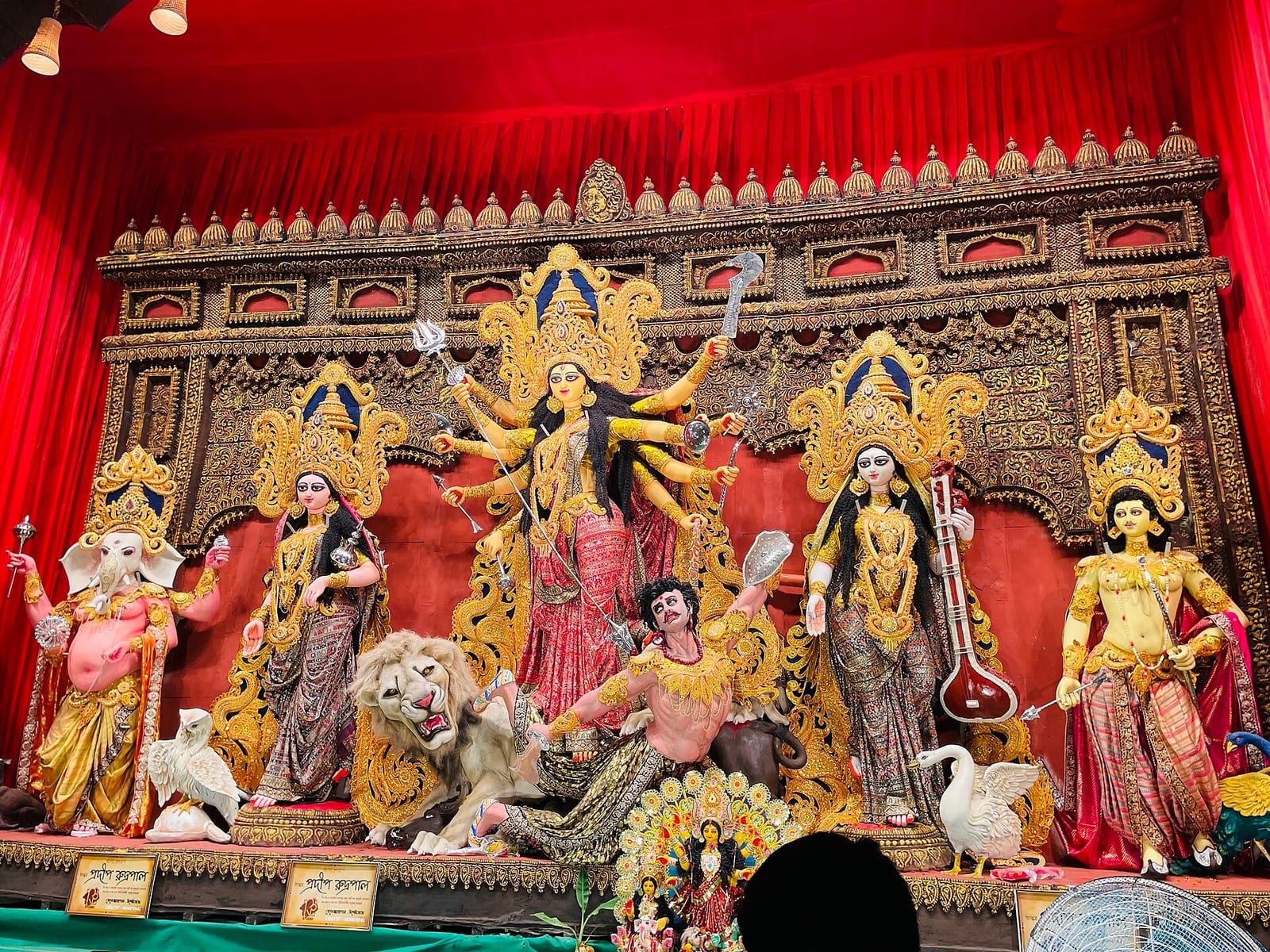
Neither is more devout than the other. One carries a family's memory; the other carries a whole neighbourhood's imagination.
A festival the world comes to see
In December 2021, UNESCO added Durga Puja in Kolkata to its Representative List of the Intangible Cultural Heritage of Humanity. The recognition brought fresh attention from abroad, and every year more visitors from other countries plan their travel around the Puja. Tour operators run guided pandal-hopping walks, heritage tours of old family pujas, and trips to Kumartuli to watch the pratimas take shape.
Since 2016 the state has also held the Durga Puja Carnival on Red Road after Dashami, where selected pujas parade their pratimas with dhakis and folk dancers before an audience that includes many foreign guests.
The Puja matters to Bengal's economy, too. A 2019 study by the British Council, commissioned by the West Bengal tourism department, valued the creative economy around the festival at about ₹32,377 crore, roughly 2.6% of the state's GDP. That money reaches idol makers, pandal builders, lighting artists, dhakis, tailors, sweet shops, hotels and street vendors. For many of them, the Puja season sustains the whole year.
Beyond Kolkata: Hooghly and Howrah
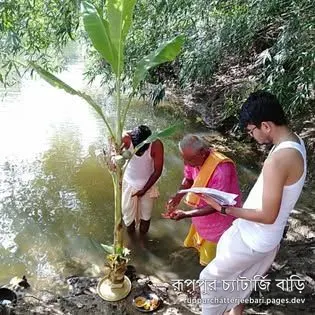
Cross the river and a quieter, older side of the Puja comes into view. Hooghly gave Bengal the barowari Puja, and towns like Chandannagar light up the whole region. Howrah is often thought of as the city by the bridge, but much of the district is rural, and its old families keep pujas that have run for generations: an ekchala pratima, rituals set by the panjika, and bhog made at home.
Our place in this story
At Ruppur Chatterjee Bari in Jagatballabpur, Howrah, the Puja began 145 years ago, in 1881, under Late Shri Krishnalal Chattopadhyay, a landlord of Ruppur. Today the fifth generation keeps it going, following Vaishnavite rituals.
If you are in Kolkata for the Puja, see the great theme pandals, and then give a day to the villages. The family pujas there are smaller and quieter, and much closer to how the Puja was celebrated for most of Bengal's history. Directions to our Durga temple are on our Visit page.