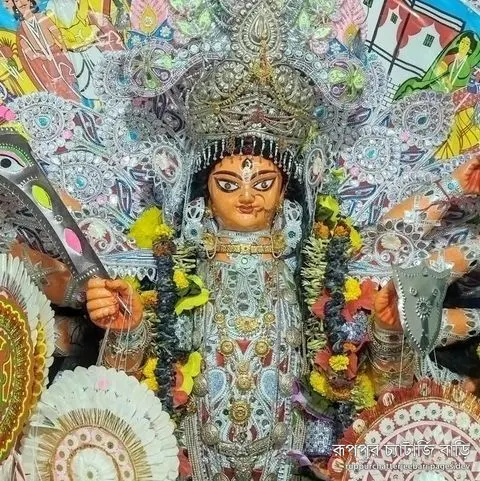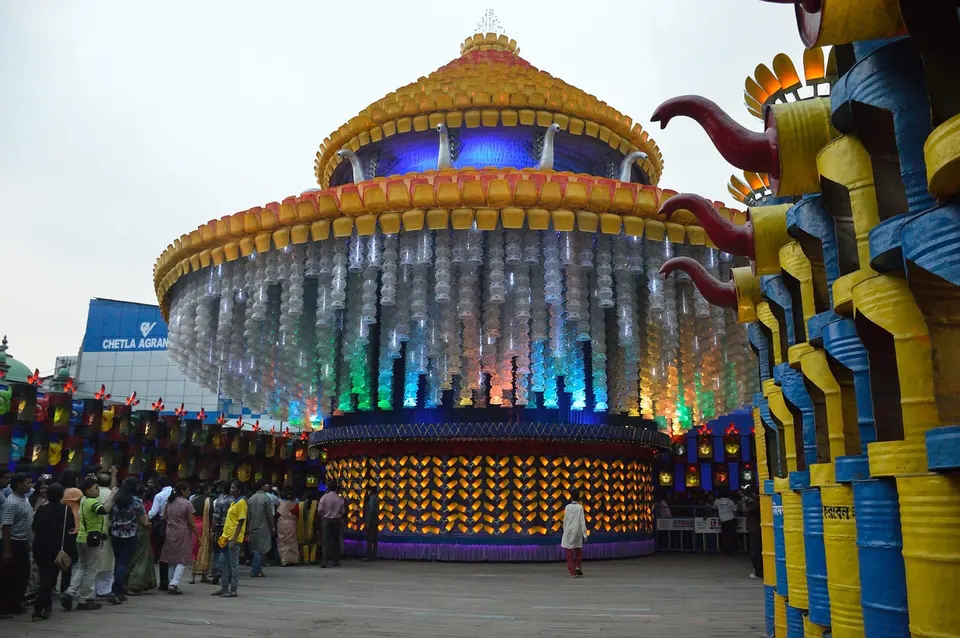
If you look at our Durga Puja 2026 nirghonto, you will notice something unusual: Maha Saptami appears twice, on Saturday 17 October and Sunday 18 October. It is not a mistake. It comes straight from the panjika, and it has to do with the way a Puja day is counted.
A Puja day is a tithi, not a date
Our calendar dates run from midnight to midnight. A Puja day does not. The days of Durga Puja follow the tithi, the lunar day.
A tithi is the time the Moon takes to move a further 12 degrees away from the Sun. Because the Moon does not travel at a steady speed, tithis are not all the same length: some last only about 20 hours, others nearly 27 hours. And a tithi can begin at any hour of the day or night.
The rule of the sunrise
For worship, the panjika looks at which tithi is present at sunrise. The tithi at sunrise gives its name to that day.
Usually each sunrise brings a new tithi. But when a tithi is long and begins shortly before one sunrise, it can still be running at the next sunrise too. Then two days share the same tithi, and the panjika marks both.
That is what happens this year. Our nirghonto shows Shashthi ending at 3:47 in the night, so Saptami has already begun before sunrise on 17 October. And it lasts long enough to still be there at sunrise on the 18th. By the panjika, both days are Saptami.
The opposite can happen too. A short tithi may begin after one sunrise and end before the next, touching no sunrise at all. Then two pujas can fall on the same day.
What happens on the second day
On 17 October, after 7:04 am, the Nabapatrika is brought in and installed, and the Saptami puja is performed.
On 18 October the nirghonto gives its own window, from 6:43 am to 5:53 pm, for the Saptamir adhik puja. Adhik means "additional": it is a second Saptami worship, held because the tithi continues. Maha Ashtami follows on 19 October, with Sandhi Puja from 7:26 to 8:14 am.
For visitors it simply means one more day of Puja this year, from Maha Shashthi on 16 October to Vijaya Dashami on 21 October 2026.